Like many utility operators, Netze Duisburg is focused on making its critical infrastructure crisis-proof. For its gas transfer stations and substations, the utility is therefore turning to modern battery storage systems with emergency power capabilities to ensure it is prepared in the event of a blackout.
Netze Duisburg ensures the city’s supply security with electricity, gas, water, and district heating around the clock. Nearly 700 employees make sure the lights stay on, water flows, and heating systems keep homes warm. In a large, densely populated, and industrial city like Duisburg, this is a complex task. Added to this are ever-changing demands from the grid itself. With the energy transition, the number of decentralized power sources is rising, and these sources are also volatile – sometimes feeding in a lot, sometimes nothing at all. The need for greater operational reliability and intelligent grid management is growing, but the technology in substations or gas transfer stations must first make this possible; at the same time there is a shortage of skilled workers. “To overcome these challenges, we need to position ourselves to be crisis-proof in many areas,” says Michael Haring, Head of Operations Engineering at Netze Duisburg. He oversees the electrical systems for gas, water, electricity, and district heating. “We maintain a total of 26 facilities and approximately 5,000 kilometers of medium-voltage lines.”
Power outage, backup power solution on
Crisis resilience means, first and foremost, that Netze Duisburg’s critical infrastructure can continue to operate independently in the event of a blackout. “Whether it’s hospitals, supermarkets, industry, or drinking water at home – the emergency supply ensures that life can continue as usual for the time being.” Here, Haring relies on backup power solutions that seamlessly step in to provide gas and water in the event of a power outage. In many parts of Duisburg, diesel generators and lead-acid batteries are still used for this purpose.
At transfer stations, these ensure the gas supply by keeping the systems operational and controllable until power is restored. But the backup solution is also essential for ensuring that the power supply can be restored at all: When the grid is restarted, loads must be connected to substations in a targeted and gradual manner, because otherwise it could collapse again immediately due to high inrush currents.
Switching to the future
But with the generators and lead-acid batteries that Netze Duisburg has relied on so far, Haring and his team are increasingly reaching their limits. While the old systems are proven, they are no longer sufficient for today’s challenges, explains Haring: “Labor costs are high because diesel fuel degrades over time and must therefore be replaced regularly. The lead-acid batteries also require extensive safety measures.”
Operational reliability also needs to be improved: “The backup power solution only kicks in during a complete grid outage, but even a partial failure can cause the system to run unstably. The generators then need 70 seconds to start up and synchronize. That’s too long – in both cases, we want to react faster. Self-sufficiency was also limited to just ten hours, but our goal is 72.” Michael Haring therefore selected a gas transfer station as a pilot project to test a new solution that is also suitable for substations. The task: to define, for the first time, a new backup power solution that is fast, digital, and future-proof
Established and reliable
Timo Kahl is responsible for electrical systems in the gas and water sector within Haring’s department. Therefore, the modernization of the gas transfer station fell under his purview. “We were looking for a technically flawless system consisting of battery storage and an inverter, but also for a partner we trust who would support us in a solution-oriented and practical way,” explains Kahl. He opted for nickel-manganese-cobalt batteries: “Compared to other systems, they are more space-efficient and have a longer service life.”
“Reinhausen is just as interested in the long term as we are. That’s how a true partnership works!”
Timo Kahl, Lead Electrician for District Heating at Netze Duisburg GmbH
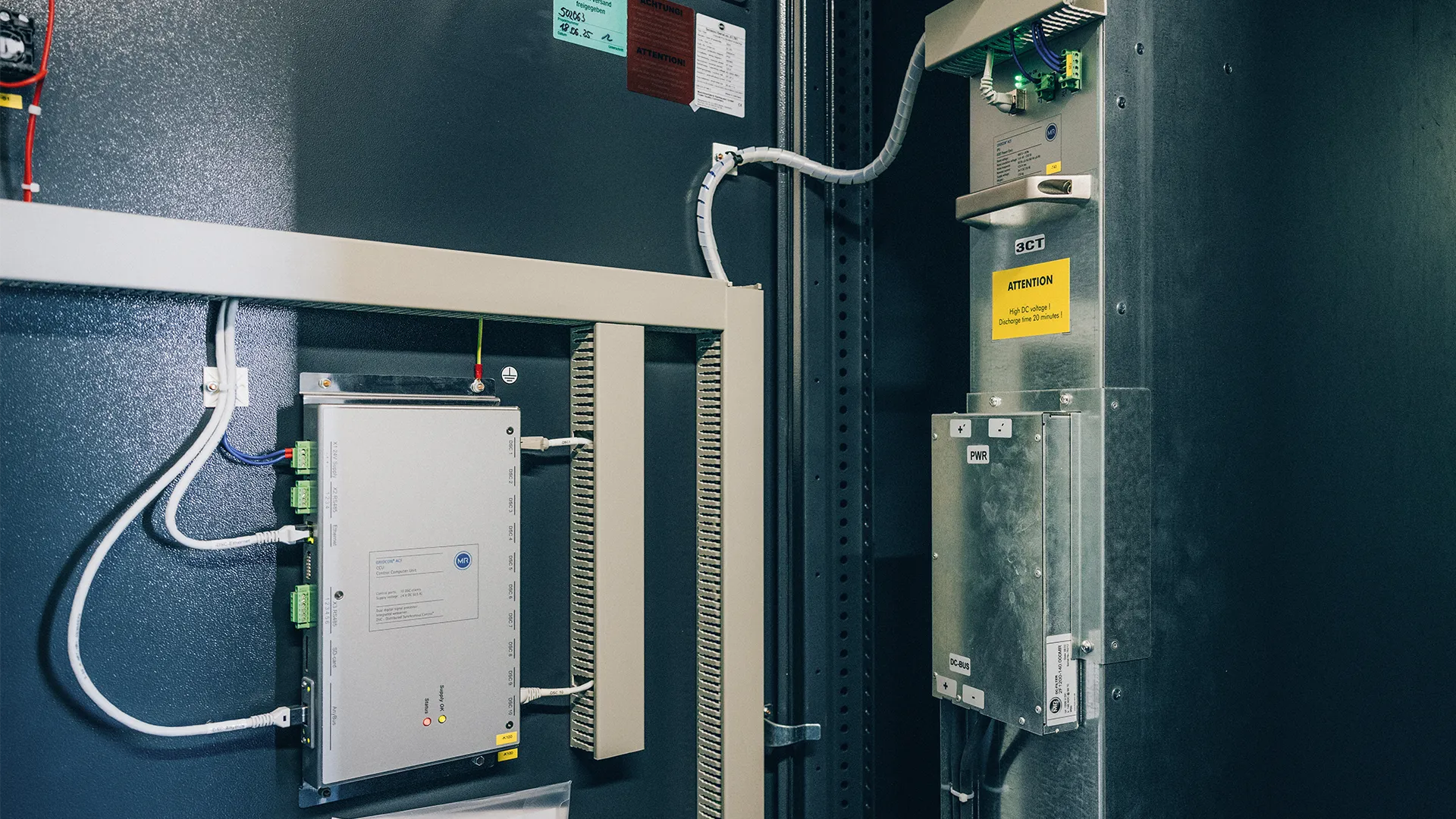
What Kahl still needed was an inverter capable of providing backup power that met the high standards for product quality, data security, and system performance. He found what he was looking for at Reinhausen: the GRIDCON® PCS inverter from Reinhausen’s Power Converters portfolio. This inverter operates in grid-following mode, meaning it adapts to the voltage, frequency, and phase angle of the power grid, thereby providing the trickle charge for the battery. Thanks to its integrated battery management system, it monitors optimal operation. If just one of the phases fails, the GRIDCON PCS® automatically switches to grid-forming mode within just 100 milliseconds – meaning the battery and inverter autonomously take over the power supply. Even in the event of a partial phase failure, everything now runs stably. The control, switching, and communication systems of the gas transfer station remain operational, remotely controllable, and integrated into the control center for up to 72 hours. The return to regular grid operation is just as fast and the battery is then recharged.
Training included
Integration with the battery storage systems was no problem. “These are established, certified solutions whose safety we can rely on. Our contacts at Reinhausen were always quick to respond and are just as committed to the long-term vision as we are. That’s how a true partnership works,” says Kahl, summarizing the decision to choose Reinhausen. The conversion at the gas transfer station was then completed quickly within a week. And as an added bonus, the new solution significantly reduces the environmental footprint compared to the old diesel system. “This helps us enormously in achieving our sustainability goals.”
The fit between Netze Duisburg and Reinhausen was also a good one on a personal level. Parallel to commissioning, the power quality experts conducted training sessions on the new system. “It’s important to us that we have the necessary know-how in-house and can operate the systems safely ourselves,” explains Haring. “That, too, means crisis resilience for us.” With the combination of modern technology and the associated expertise, Netze Duisburg has found a future-proof solution – and one that can now be applied to many other gas transfer stations and substations throughout the city.
Reinhausen inside
The innovative GRIDCON® PCS XW provides a secure and stable power supply that can be managed locally anytime, anywhere. Designed for fail-safe reliability, this smart inverter enables modern microgrids and seamlessly integrates renewable energy generation, storage capacities, DC grids, and emergency power supply.
Battery storage systems can also be coupled with the GRIDCON® DC Charger, a flexible, efficient, and future-proof charging station developed by Reinhausen Power Quality with a direct DC grid connection for local DC grids.

YOUR CONTACT
Do you have questions about the solution?
Andreas is here to help:
A.Stoll@reinhausen.com