For the Hornsea 3 offshore wind farm off the coast of England, SeAH Wind is building one of the largest monopile factories of its kind. To ensure production can keep up with the high capacity utilization, Enspec Power, with support from Reinhausen, is ensuring optimal power quality.
In the North Sea, some 120 kilometers off the British coast, Hornsea 3 – one of the world’s largest offshore wind farms – is set to be completed by 2027. Constructed by the Danish energy company Ørsted, it is expected to supply over three million households in the UK with electricity upon completion, with a capacity of 2.85 gigawatts. To this end, Ørsted is installing several hundred wind turbines across an area of nearly 700 square kilometers on the high seas. To withstand waves and storms, they are anchored to the seabed with massive steel piles, known as monopiles.
The company SeAH Wind specializes in the construction of these foundations. Extra for the Hornsea 3 project, the manufacturer has built the world’s largest monopile factory to date in Teeside, in the northeast of England. The site is thus one of the most important among several suppliers for Hornsea 3. To put the dimensions into perspective: Some of the monopiles are over 100 meters long and weigh more than 2,000 tons. Production is designed so that SeAH Wind can manufacture up to 200 of these giants per year.
3
Million
Households
are supplied with electricity by the wind farm.
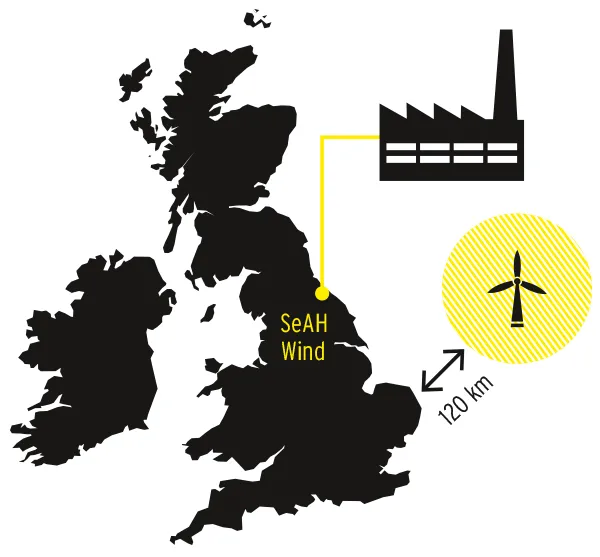
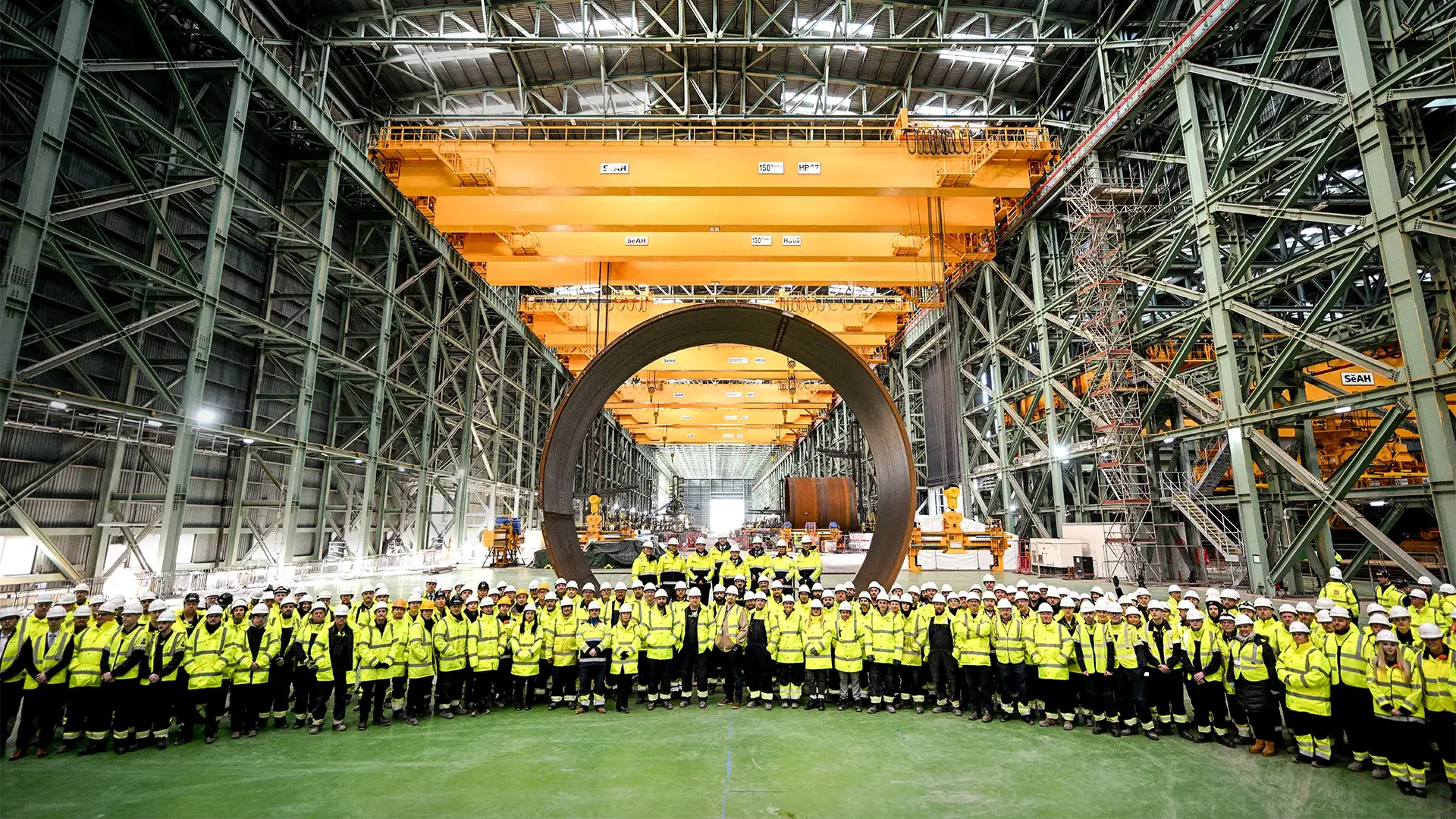
SeaH Wind’s monopile factory is located on the site of a former steelworks in Middlesbrough and is one of several suppliers for Hornsea 3.
2,8
Gigawatt
capacity
capacity expected to be Hornsea 3’s capacity upon completion.
Target: Stable plant network
Early in the factory’s planning phase, SES Engineering – the general contractor for building services, and a member of the Wates Group – commissioned the firm Enspec Power to design a robust plant power distribution system. This is because voltage quality is critical for reliable operation, ensuring the factory meets grid connection requirements and preventing damage to the machinery.
For Tony Jefferson, who led the project at Enspec Power, this was no easy task: “When we received the contract in 2024, the factory existed only as a blueprint. So our work relied on predictive system modelling rather than physical measurements.” To get a rough idea of the expected challenges regarding power quality, Enspec Power therefore first created a virtual model of the factory in collaboration with SES Engineering.
“In my experience, MR manufactures the world’s best filters for industry.”
Tony Jefferson, Director of New Markets and Enterprise Development at Enspec Power Ltd

Tested on the model
“We were able to estimate that some of the equipment would cause significant reactive power demand – that is, electrical energy that isn’t converted into useful work and strains the system,” reports Jefferson. But that isn’t the only problem: “We know from experience that harmonics always occur. It’s a very dynamic process that simply requires a lot of power,” says Jefferson.
And here’s how the process works: First, a cutting system cuts solid steel plates into large rectangles. Then rollers bend the steel strips into a circular shape, which welding machines weld together at the ends. This is where things get critical: “The welding machines cause the largest share of the harmonics; but other machines, such as the rollers, also generate harmonics. This is due to their frequency converters,” says Jefferson.
These ensure that SeAH Wind can flexibly adapt the speed of the motors of the highly automated systems to production requirements. While this makes the use of the machines efficient, it also generates harmonics. If these aren’t filtered out, they can interfere with upstream and downstream systems. In the worst case, they can even cause damage.
Better safe than sorry
“Because the operational loading profile would evolve over time, the solution needed to be scalable and flexible enough to adapt alongside production requirements.” says Jefferson. He didn’t have to think long about where to turn for help because Enspec Power has been working with Reinhausen for about seven years. So he quickly picked up the phone to consult with Kim Urbanke and Henning Tischer from the Power Quality Converters business unit.

An idea was quickly born: modular control cabinets with power electronics from Reinhausen. A total of 29 active filters based on Reinhausen technology compensate for harmonics in real time. In addition, there are 26 reactive power compensation systems. This ensures power quality even under high loads. Jefferson says: “In my experience, MR manufactures the world’s best filters for industry. They respond dynamically to changing loads and can be precisely controlled.”
Turnkey solution
Thanks to the modular principle, Enspec Power can deliver the power required at each connection point – and easily and safely expand the system as needed. Enspec Power not only designed the solution but also manufactured it at its production site in Washington and subsequently installed it, in collaboration with SES Engineering, at the XXL factory. For the region, the factory serves as a springboard for becoming an industrial hub for wind power. Jefferson is proud of the project: “This factory is an example of how the energy transition is transforming industrial regions and catalyzing economic growth.”

YOUR CONTACT
Do you have any questions about the solution?
Henning Tischer is there for you:
H.Tischer@reinhausen.com