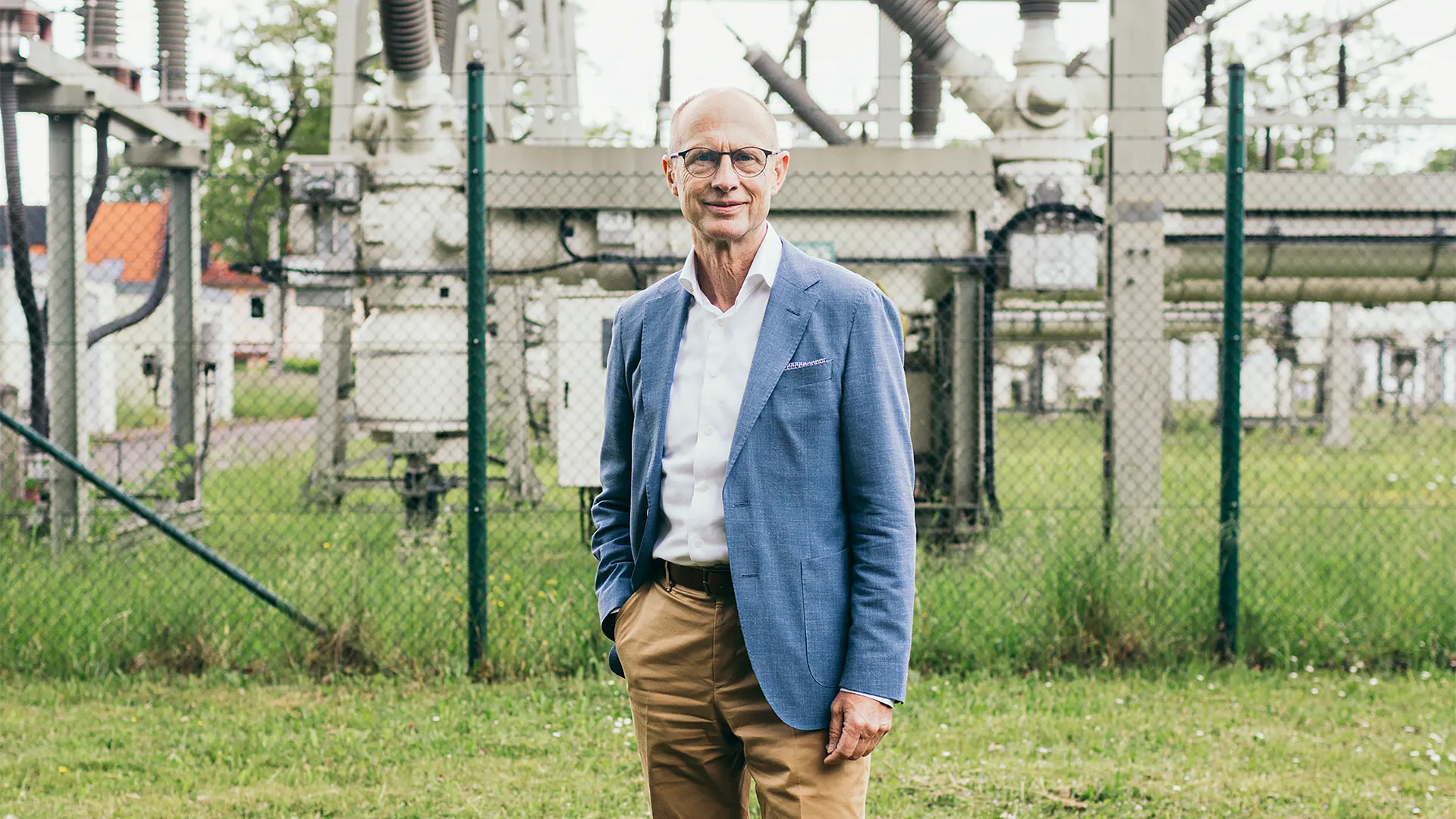
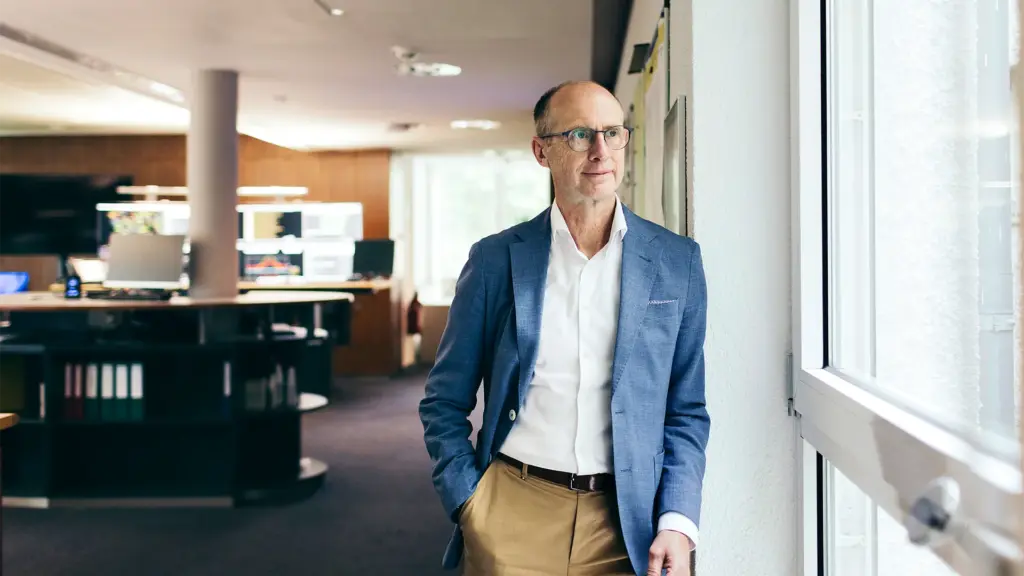
Dr. Egon Leo Westphal has been CEO of Bayernwerk AG since 2021. For him, energy grids are the backbone of the energy transition.
Looking back, how important was the invention of the high-speed resistor-type tap changer?
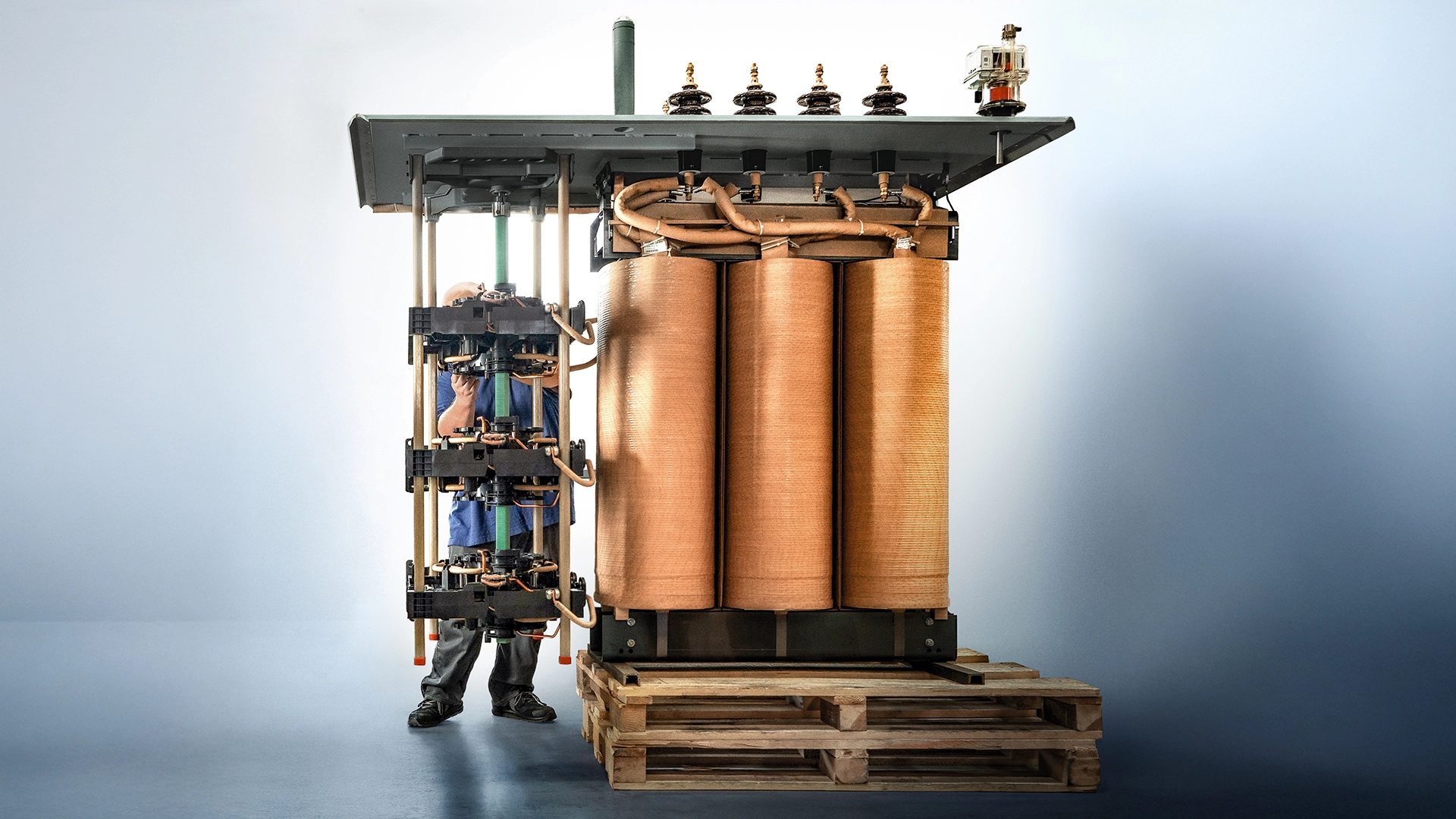
Quite clearly, it’s often the more hidden things that achieve great things. Who – apart from tech enthusiasts – would think of revolutionary developments when hearing about high-speed resistor-type tap changers? But that’s exactly what we’re talking about. Grid operation as we know it today would not have been technically or economically feasible without the invention of the high-speed resistor-type tap changer. It was this invention that first made it possible to implement large, interconnected grids in practice and maintain stable voltage over long distances.
The invention of the high-speed resistor-type tap changer 100 years ago was thus one of the decisive technological breakthroughs and a key innovation for the development of modern power grids. This tap changer, which was novel at the time, made it possible to precisely regulate transformers under load and thus stably interconnect different voltage levels. For today’s Bayernwerk AG and our predecessor organizations, this innovation was of fundamental importance because it created the conditions necessary to develop a high-performance, integrated power grid from a multitude of individual regional energy supply solutions. The high-speed resistor-type tap changer also made it possible to precisely control load flows, which ultimately led to the quality and reliability of today’s power supply. Looking back, it can therefore be said that this invention went far beyond its immediate technical benefits.
“The invention of the high-speed resistor-type tap changer was thus a key innovation for the development of modern power grids.”
Rather, it laid the foundation for scaling up the energy supply and – as we must recognize – thereby also for the industrialization of the Free State of Bavaria. Bernhard Jansen’s high-speed resistor-type tap changer is not an obsolete relic even in today’s innovative distribution network operations, but rather a proven fundamental component. While its direct dominance is waning in dynamic, decentralized networks, its conceptual significance remains central because a large part of today’s voltage regulation technology is based on it or has evolved from it.
Bayernwerk AG and Reinhausen have been collaborating for decades. What connects the two companies?
When we talk about the connection between our companies, we quickly come back to the high-speed resistor-type tap changer and its inventor, Dr.-Ing. Bernhard Jansen. And in doing so, we encounter a story that’s almost like a fairy tale. In November 1928, Jansen took up the position of technical director at Oberpfalzwerke AG für Elektrizitätsversorgung (OWAG) in Regensburg, one of the predecessor companies of today’s Bayernwerk.
Jansen held the patent for his high-speed resistor-type tap changer but until then it had remained purely theoretical. There was a shortage of high-quality gears for his coupled double-gear mechanism designed for step-by-step regulation of transformers under load. If tradition is to be believed, Jansen walked into the workshop of Oskar and Richard Scheubeck in Reinhausen a year later and, according to the story, an apprentice of the Scheubeck brothers achieved in just one day what no one had managed to do before. Visibly impressed, OWAG CEO Jansen then promised the brothers further orders. I think this story about the early days of our collaboration is emblematic of everything that followed.
Over the years, a trusting collaboration has developed that goes far beyond a traditional supplier relationship and is instead based on a partnership in developing solutions for a continuously evolving energy system. In my opinion, this is founded on a shared understanding of the central role of technology in energy supply, as well as high standards of quality, reliability, and innovation. And if I may broaden the perspective a bit, with a nod to the apprentice from 1929: supporting young people, letting them just give it a try, and allowing their unclouded perspectives on challenges to enable innovation – that suits us well today more than ever.

In your view, what are the most important milestones in the collaboration with Reinhausen?
These milestones can be traced along the major developmental stages of the energy supply sector. In the early phase of grid expansion, the focus was initially on the technical prerequisites for developing a stable interconnected grid from fragmented structures – a feat made possible in particular by the introduction of adjustable transformers and the transition to uniform voltage levels. After World War II, the effectiveness of these concepts became evident in the rapid reconstruction and reorganization of the power supply, during which existing grid segments could be quickly reintegrated into a functioning overall system.
In the 1950s, a phase of strong growth followed, during which the grid was massively expanded, and supply was significantly extended across the country, as reflected, among other things, in a multiplication of grid lengths and the number of transformer stations. At the same time, projects such as the pumped-storage plant on the Pfreimd River in the Schwandorf county of Bavaria created flexibility options early on that now play a central role again in the context of the energy transition. Here, too, we once again encounter the visionary Bernhard Jansen, who was the initiator of the power plant group. It was not without reason that OBAG renamed the power plant complex on the Pfreimd the “Jansen Pumped-Storage Plant Group” in May 1959.
This development illustrates that collaboration has always been particularly influential when technological innovation and systemic development have been able to interlock. Here’s another example of consistency: For more than 50 years, we have used almost exclusively Reinhausen on-load tap-changers in our transformers. Our experts from the substation operations team are full of praise: “These devices last the entire lifespan of a transformer!” And the development of vacuum switching tubes was a brilliant move – now even less maintenance is required.
What are the biggest challenges currently facing Bayernwerk AG?
Our work is shaped by the dynamics of the energy transition, which is transforming the energy system at a pace that is historically unprecedented. And we have to keep up with this pace – which we are doing. The massive expansion of renewable energy, particularly decentralized generation facilities, is leading to increasing volatility and complexity in grid operations. On the Bayernwerk Netz GmbH grid alone, there are currently more than one million renewable energy installations, the vast majority of which are PV systems.
In total, nearly 24,000 megawatts of renewable capacity are directly connected to the Bayernwerk Netz GmbH grid today. But that’s not all: We expect renewable generation capacity in Bavaria to triple by 2045. During the same period, we anticipate that electricity consumption will double, and we are also seeing a surge in inquiries from large consumers such as data centers, particularly in the Munich area and the Würzburg/Aschaffenburg region. The energy system is thus becoming the central platform for digital transformation. That’s a game changer. Another game changer is flexibility.
What do you mean by “flexibility”?
Storage solutions. In terms of storage capacity, we’re rapidly approaching about 50 percent of our peak load of 8,000 megawatts across all segments, driven by strong growth in residential and green energy storage systems. Bavaria, the “land of storage,” is thus flourishing. In a sense, this raises questions similar to those that arose in the early phase of electrification – namely, how different generation and consumption structures can be efficiently integrated and operated in a stable manner. The crucial difference, however, lies in the speed and scale at which this transformation is taking place. Today, this transformation is occurring not over decades, but within just a few years.
At the same time, we are witnessing the shift from a centralized to a decentralized energy system – a system we described many years ago in our “Flower-Power” concept. Back then, Flower-Power was the vision of a system in which the rural “leaves,” with their high generation capacity, supply the urban “flower,” with its high demand. A system with local energy cycles made possible by flexibility. In other words: The energy transition is taking place in rural areas. And we’re seeing more and more “Flexumers” – people who not only consume and produce energy but also store it, use it themselves, or make it available close to the point of generation. That’s true local energy. And that’s what makes the energy system of the future a real hit.
How exactly is Bayernwerk AG managing the energy transition and the transformation of the grids?
The Bayernwerk Group is addressing these challenges with an integrated approach that consistently combines grid expansion, system integration, and digitalization. In 2022, we launched the “Growth Initiative: Bavaria’s Energy Future,” and we are steadfastly continuing on this path, investing approximately 12 billion euros in Bavaria’s energy transition from 2026 to 2030. Last year alone, we expanded the capacity of 15 substations, installed over 1,700 digital local network stations, laid 177 kilometers of high-voltage lines, nearly 1,600 kilometers of medium-voltage cables, and an additional 1,600 kilometers of low-voltage cables. These are figures that were completely unthinkable just a few years ago — seemingly far removed from reality. Today, they are a reality. And this trend will continue in the coming years.
The expansion of the grid infrastructure thus creates the necessary capacity for feeding renewable energy into the grid, while at the same time bringing additional flexibility to the system through the integration of storage systems. A word specifically on large-scale storage systems: We must proceed with caution here, as they interact with the public grid. Storage systems operated solely based on market-driven objectives can place a strain on the grid. And anything that exacerbates existing grid bottlenecks is problematic. We therefore prefer grid-neutral and grid-supporting storage solutions. We’re currently facing a mountain of applications for large-scale battery storage – with a capacity that simply cannot and will not be realized.
We’re currently talking about over 80,000 megawatts, well over ten times our peak load. It’s important to separate the wheat from the chaff here and, above all, to remain realistic. Large-scale storage systems still require systemic and technical regulations. This is an ongoing development process. Moreover, it’s not just about storage. We’re also looking at data centers, the economic development of commerce and industry, decarbonization, housing construction, digitalization, heat supply, e‑mobility for passenger cars, and soon for trucks – all of which need electricity, all of which need the grid. This creates a logical rush for grid capacity, which is increasingly turning it into the “gold” of the energy transition.
In your view, what are the most important technical and organizational levers for managing this dynamic?
The central challenge today is to make the increasing complexity of the energy system manageable. We have unleashed renewables. We have unleashed the grids. Now the goal is to unleash the entire energy system. To achieve this, we are relying on a combination of technological and organizational levers. Digitalization plays a key role here, as it enables near-real-time grid control for the first time, thereby creating the prerequisite for active system management. At the same time, processes are being standardized and scaled to implement the necessary expansion at the required pace.
For example, we have defined standard sizes for substations, are committed to long-term, reliably predictable collaboration with our partner companies, have revamped our inventory and logistics management, and are adapting our IT processes on an enormous scale – because for us as a grid operator, the energy transition means, above all, mass processes. In addition, forward-looking planning based on data analysis and scenarios is becoming increasingly important, as it helps us anticipate future developments early on. Overall, this creates a system that remains stable and controllable despite growing dynamics.
“We have unleashed renewables. We have unleashed the grids. Now it’s time to unleash the entire energy system.”
One example of this is the use of artificial intelligence, which helps us efficiently utilize the grid based on real-time data and thus make optimal use of available capacity. We are Germany’s first distribution network operator to build a grid-supporting storage facility, which is scheduled to go into operation this year in the Cham district. We are driving innovation forward: With the “feed-in-socket” concept, we are proactively and strategically providing capacity for connecting renewable energy sources.
This integration enables the optimized use of grid connection points – for example, by connecting wind power to an existing PV feed-in point. In summary, our organizational and technological innovation is crucial for balancing tomorrow’s energy system and getting it up and running properly.
What are your expectations today regarding collaboration with manufacturers and technology partners such as Reinhausen?
Expectations for partners like Reinhausen have expanded significantly in the wake of the energy system’s transformation and are now more strategically oriented than ever before. In addition to high product quality and reliability, what matters increasingly is the ability to jointly drive technological developments and to conceive of solutions that span the entire lifecycle of systems. This also includes the integration of digital functions that enable equipment to be intelligently integrated into the overall system. Historically, close collaboration between grid operators and technology partners has already been a key success factor in building out the energy supply infrastructure.
This logic applies today more than ever, because the transformation of the grids can only succeed through close collaboration among all stakeholders. That is why we are also increasing our involvement in research projects. And we are establishing new communication formats. For example, our “Partner.Live: TechnikDialog” celebrated its premiere at the end of April. More than 160 representatives from partner companies, universities, and research institutions came together to discuss future technical topics in the energy and grid sectors. The goal: to bridge the gap between theory and practice, generate momentum, further develop ideas, and foster collaboration. It goes without saying that Reinhausen was there to present its dynamic setpoint control for adjustable local network transformers. Thank you very much for that!
In general, one thing is clear to me: The energy transition is a collective effort. It is arguably the largest digitalization project of our time. And it is a massive transformation process. The energy transition will only succeed if all stakeholders understand their roles and are prepared to make their respective contributions as part of a community of responsibility. Bayernwerk is the engine room of the energy transition. We are able to do this thanks to long-standing partners like Reinhausen.
I read on the Reinhausen website: “Our mission is true innovation: Together with our customers, we are shaping the energy transition.” I wholeheartedly agree with that. We share values such as trust, reliability, and commitment. I think that’s at least as important as technical innovation. I appreciate that very much. And I’m also very grateful for it. Together, we’re shaping the future of our grids – with technologies that set new standards and concepts that enable growth.
Bayernwerk AG
Bayernwerk was founded in 1921 on the initiative of civil engineer Oskar von Miller. His vision was to provide electricity throughout all of Bavaria and to expand the previously fragmented power infrastructure into a unified grid. Today, Bayernwerk AG, headquartered in Regensburg, is one of Germany’s largest distribution network operators and operates a network approximately 157,000 kilometers long.